Making my agent find my own CLI helpers
15 Oct 2026Over the years, I made myself a long list of CLI helpers. Stuff like git-worktree-create or video-volume-increase. They help me get the info I want or do the action I need without having to remember the exact underlying command and args to type.
But when I ask Claude to create a branch or get me the dimensions of a video, it would use bare git or ffmpeg commands. That inconsistency buggued me at first but I thought that given the agent was smarter than I was, it didn't need an alias, it could just remember the complete and complex command so it didn't really matter.
Well, it mattered, actually
When I ask the agent for a new worktree, what I have in mind is running my custom git-worktree-create helper. I packed a lot of complexity away behind that command:
- It stops early when the current directory is not a git repository.
- It starts a new branch.
- It creates the worktree folder in a shared directory, with a naming convention.
- It handles git submodules.
- It installs dependencies.
- It handles edge cases (invalid chars in branch names, etc.).
- It also takes care of some edge cases or additional tweaks for some specific repos.
This command started as a simple git worktree add /worktree/dir branch-name wrapper but grew over time to the complex beast it is today. And its tests grew with it. That command does exactly what I want it to do, and I have tests to prove it now. I feel safe using it, knowing it will do exactly what I expect it to do.
Letting the agent know
I'd like the agent to use that helper. But the agent doesn't know about it. It still thinks "Creating a worktree" is running git worktree add /worktree/dir branch-name and that's it.
I found myself having to tell it: "Use the git-worktree-create helper instead." often. And I had to do that for all my helpers.
I started adding lines into my CLAUDE.md to tell it about my favorite helpers but I quickly realized it wouldn't scale with the 1000+ helpers I currently have.
What I did instead was writing two other helpers. helper-list would list all my helpers and helper-documentation would explain how to use on.
helper-list
helper-list takes a query and returns only the helpers that match that query.
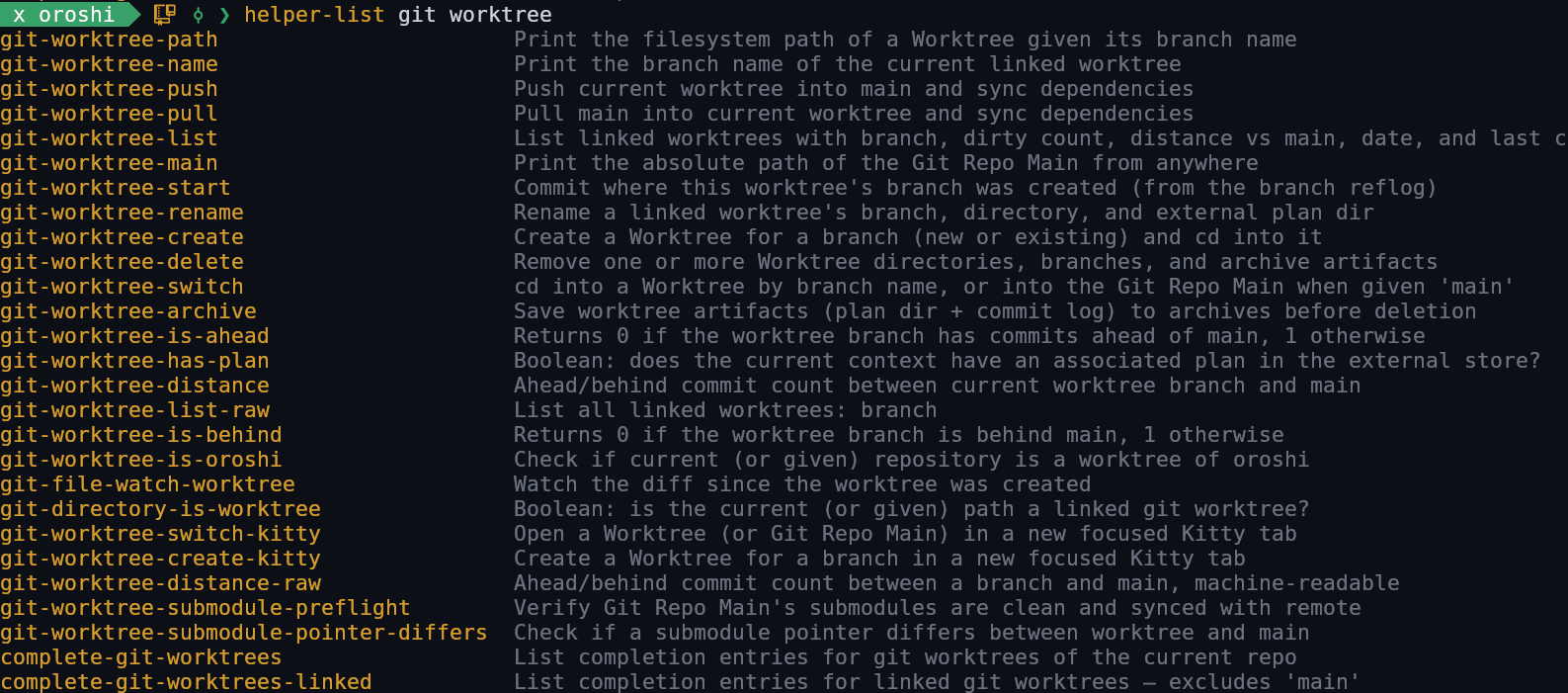
All my helpers follow a consistent naming scheme of <domain>-<object>-<action>. For example git-branch-create, docker-image-list, notion-page-read, etc.
Finding them is a matter of piping find into fzf to get some fuzzy-matching against the query and displaying them. As my helpers have explicit enough names, the agent can guess which one would be useful to it.
helper-documentation
Knowing that a helper exists is only the first step. Now the agent needs to know how to use it. helper-documentation takes a helper name as input, and returns its header documentation comments (including description, usage, etc).

By making sure all my helpers are properly documented, documentation usage can easily be resurfaced to the agent.
CLAUDE.md
To wrap this all together, here is what I added to my CLAUDE.md:
Prefer dedicated CLI helpers over raw commands.
Examples:


| Instead of…              | Use…                         |
|--------------------------|------------------------------|
| `git` complex pipelines  | `git-*` helpers              |
| `convert`, `imagemagick` | `img-*` helpers              |
| `ffmpeg` pipelines       | `audio-*`, `video-*` helpers |


Discover helpers with `helper-list <domain> [action]`.
Read the flags and usage of a helper with `helper-documentation <name>`.
The result
Now, I can just focus on adding more helpers and more helpers, following my naming convention and documenting them properly. I'm assured my agent will be able to use them without me having to update anything in my CLAUDE.md. Those helpers are useful to both me and the agent.
A helper that finds my other helpers feels a bit meta, but it works really well.
One more benefit is that I can now configure Claude to allow specific commands (like git-worktree-create) without needing to give it a blanket permission to the whole git command.
Want to add something ? Feel free to get in touch on Bluesky : @pixelastic.bsky.social